noir. Two figures printed on black, thirty of each, released one after the other. The plates read the way they do on a screen in a dark room rather than on paper.
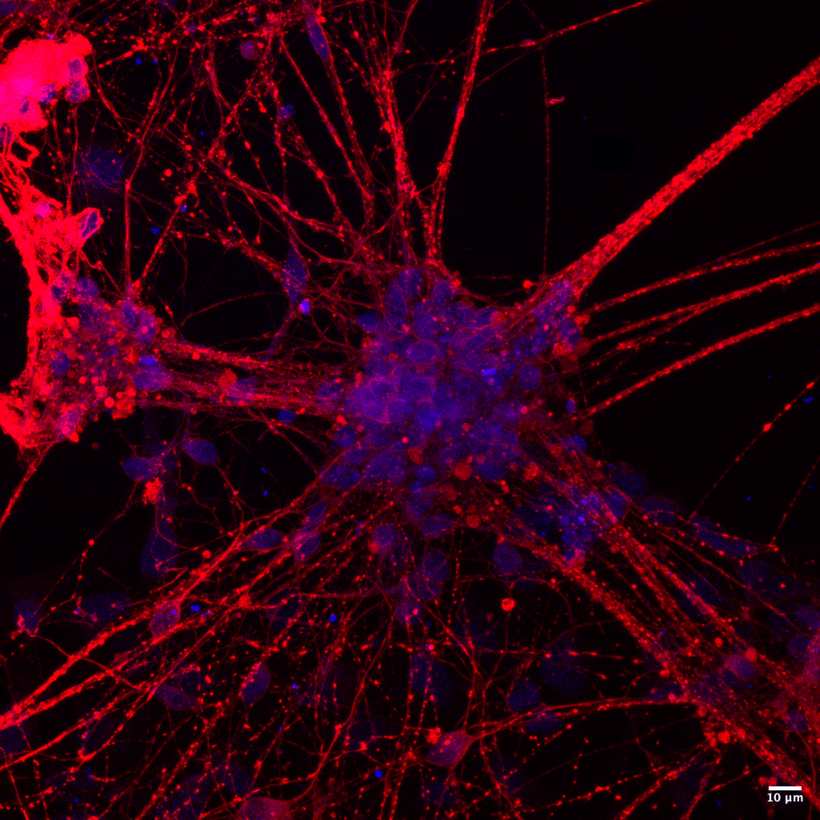
Parkinson's involves the death of the neurons that produce dopamine. This work grew those neurons from human stem cells in order to study how astrocytes, the brain’s support cells, can turn against them during inflammation.
What you are looking at is a real culture of human dopaminergic neurons, stained so that the nucleus and the neuron’s internal scaffolding show up in different colours.
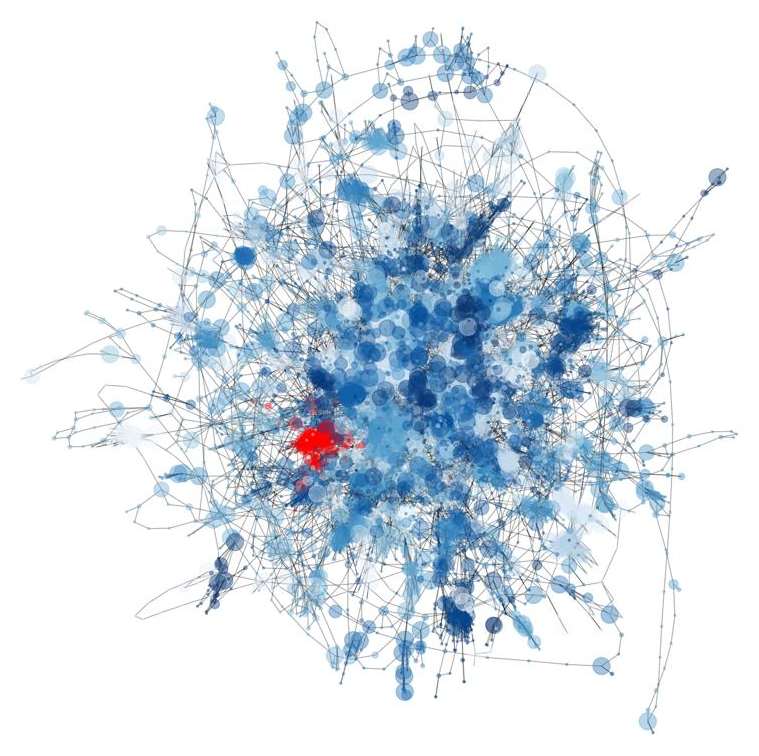
Some proteins, especially ones linked to diseases like Alzheimer's, do not hold a fixed shape. They are constantly moving and changing, which makes it hard to design a drug that can attach to them in a stable way.
This work studied how an Alzheimer’s-related protein, Aβ42, interacts with a small molecule called 10074-G5, using computer simulations to watch the interaction. Even while connected, the protein stays very flexible. Rather than a single lock-and-key site, the model shows the molecule moving around the protein’s surface, briefly attaching in many different places.
Thinking of binding as a path across many possible spots, rather than one fixed target, opens new ways to find drug-friendly regions on proteins like this one.